Routeplane sits between your application and the model providers. Everything it does happens in one pass over the request, before a provider is chosen and again on the way back — there is no sidecar to run, no agent to install, and no SDK to adopt.
The request path
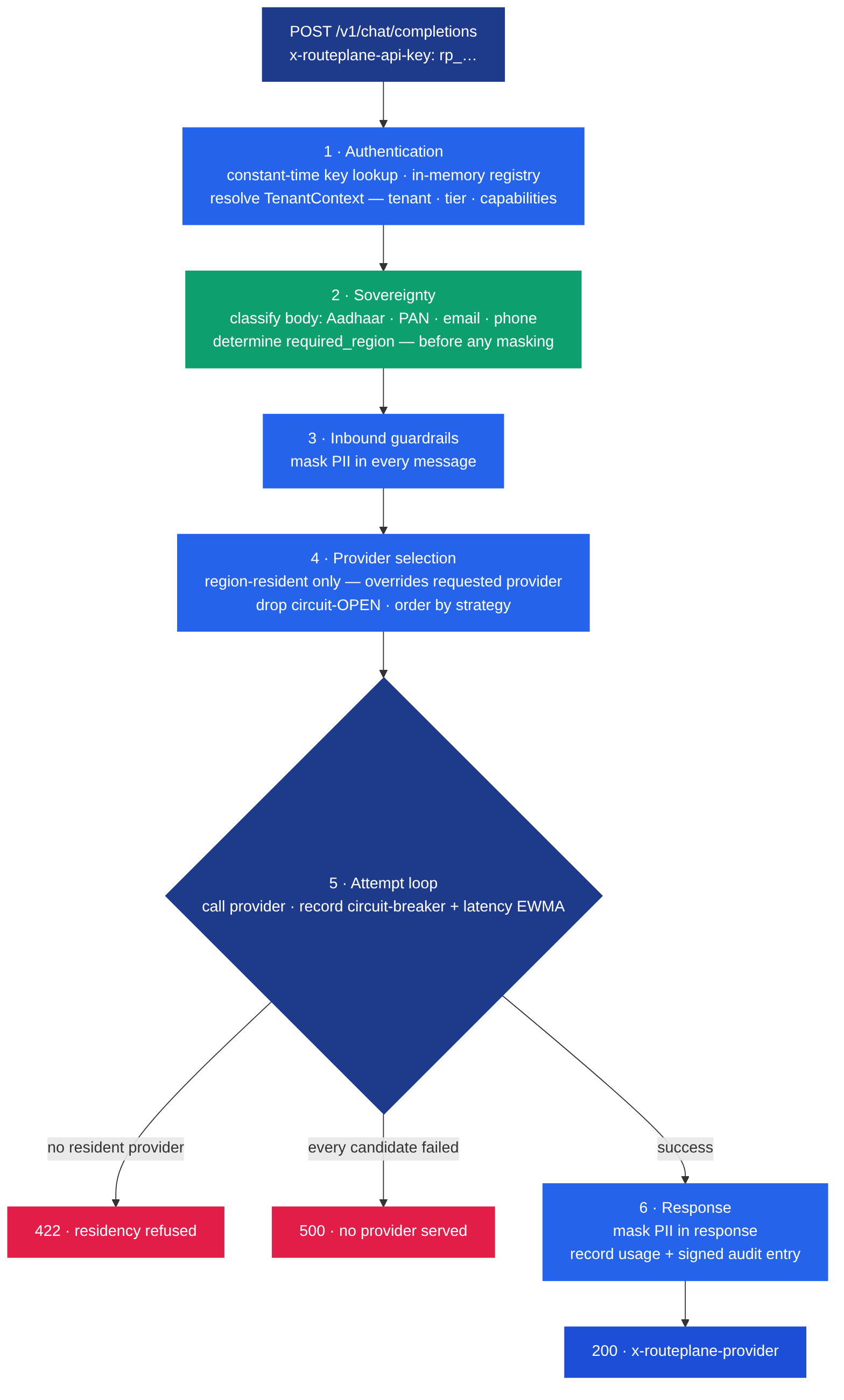
Every call takes the same route. The order matters more than it looks, and one step in particular is deliberately placed where it is.
Why classification comes before masking
Masking personal data and detecting personal data are the same problem read in opposite directions. If masking ran first, the classifier would inspect a message whose Aadhaar numbers and phone numbers had already been replaced with placeholders, find nothing regulated, and conclude the request was free to route anywhere.
So classification runs against the original text and masking runs after it. The residency decision is made on what you actually sent; the provider only ever sees the masked version.
Sovereign routing
This is the part with no equivalent in other gateways, and the reason the ordering above is load-bearing. Most gateways route by the region you declare. Routeplane reads the request body and enforces the region the content requires.
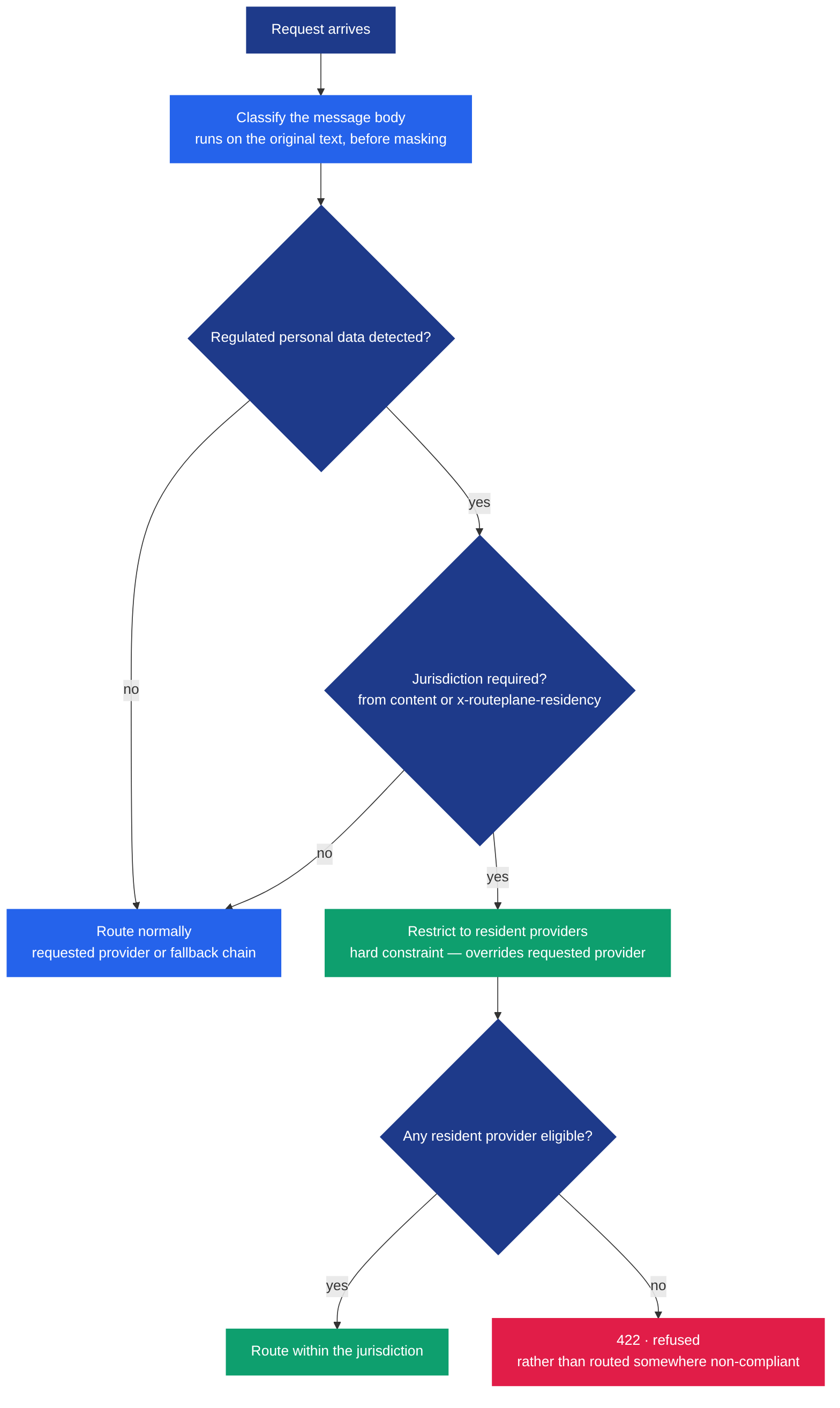
Two properties are worth stating plainly, because they are the ones an auditor will ask about:
- It overrides you. If the content requires a jurisdiction, the requested provider loses. A header cannot widen the constraint, only narrow it.
- It fails closed. When no resident provider is eligible the request is refused with
422. It is never quietly downgraded to a non-compliant route, because a compliance control that degrades under pressure is not a control.
Detection today covers the India/DPDP profile — Aadhaar (checksum-validated, not merely pattern-matched), PAN, email, and phone. The engine itself is jurisdiction-generic: adding a profile means adding recognisers, not rewriting routing.
Failure and fallback
A gateway's value is mostly visible when a provider is having a bad day. Routeplane tracks the health of each provider independently and routes around the unhealthy ones without you doing anything.
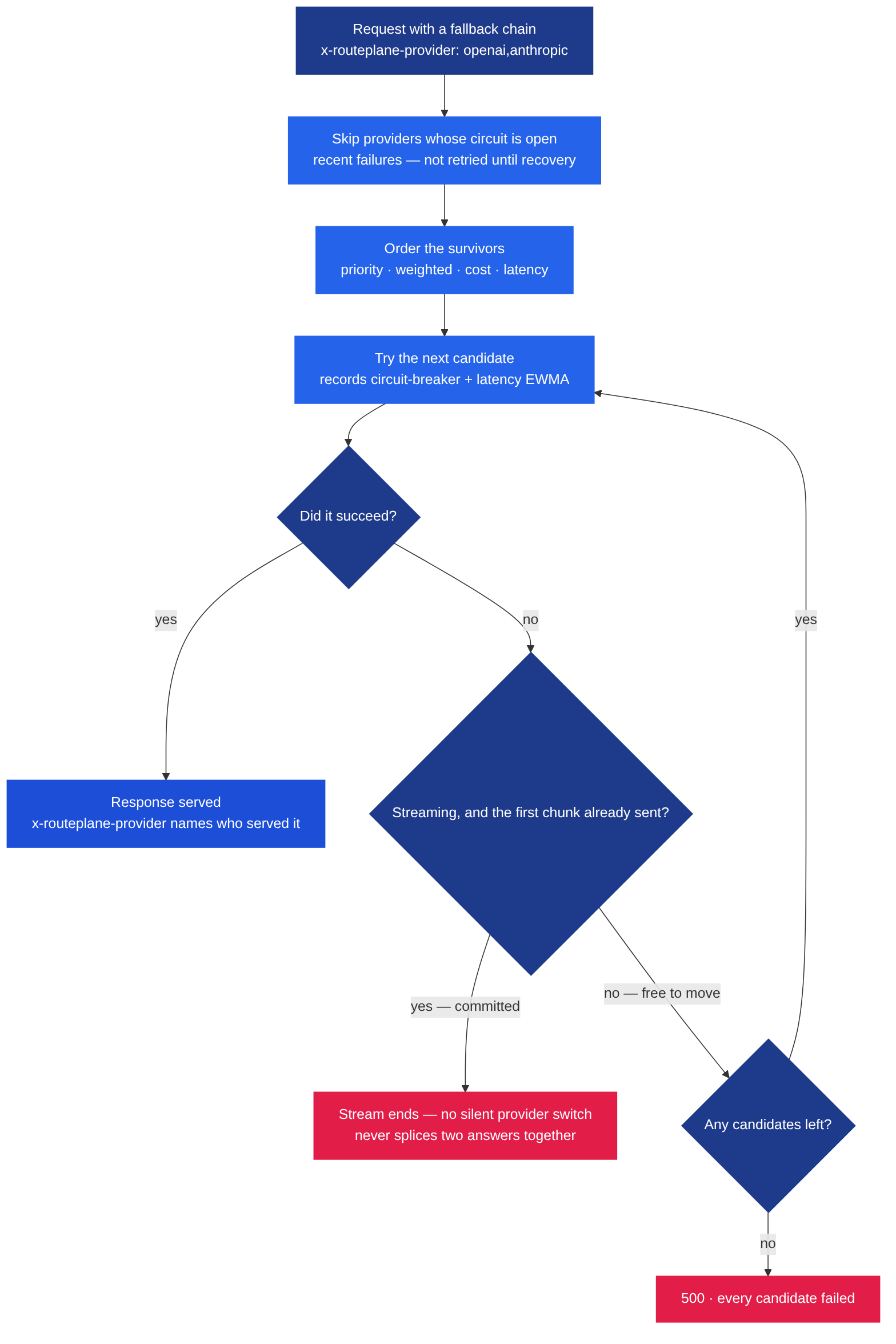
The streaming rule is the non-obvious one. Once the first chunk of a streamed answer has been sent, the gateway is committed to that provider. If it then fails, the stream ends rather than restarting on another provider — because the alternative is splicing the first half of one model's answer onto the second half of another's and returning it as a single coherent response. Ending honestly is better than that.
Failed attempts still feed the provider's health signals, so a provider that is failing gets its circuit opened and stops being tried until it recovers.
Providers
Requests fan out to OpenAI, Anthropic, Azure OpenAI, Google Gemini, AWS Bedrock, Mistral, Cohere, Groq, DeepSeek, Together, Fireworks, xAI and OpenRouter — fourteen adapters in all, including a generic adapter for any OpenAI-compatible endpoint, which covers self-hosted Ollama, vLLM and LocalAI.
Each adapter translates the canonical request into that provider's native API and back, so a fallback chain can span providers whose wire formats have nothing in common. Selection is made per request by your routing policy, and overridden by sovereign routing whenever regulated data applies.
What runs where
Provider credentials are held by the gateway and resolved server-side against your virtual key. Your application holds one Routeplane key and never sees a provider key, which is what makes rotating a provider credential an operation you perform in one place rather than a redeploy of every service.
Tenants are separated at the deployment topology — shared pools and dedicated environments — rather than by a filter on a shared table.
Design properties
Some characteristics follow from the architecture rather than from tuning, and those are the ones worth relying on:
- No garbage collector. The data plane is Rust, so there is no runtime GC and therefore no GC pause to appear in your tail latency.
- A lock-free hot path. Circuit breakers and latency tracking use atomics rather than mutexes, so provider health accounting does not serialise concurrent requests.
- Scale to zero. The gateway is serverless and scales down to nothing when idle, which is why a dedicated environment is not priced like one.
- Bounded, non-blocking telemetry. Observability is off the request path. Under pressure it drops records and counts the drops rather than slowing the request that produced them.